Kitchen note 006 · Cookware
Choose induction cookware with five fit tests
“Induction compatible” is a first gate, not a complete specification. Test the magnetic base, measure the area that actually couples with the zone, check flatness and handling, then verify every heat and care limit.
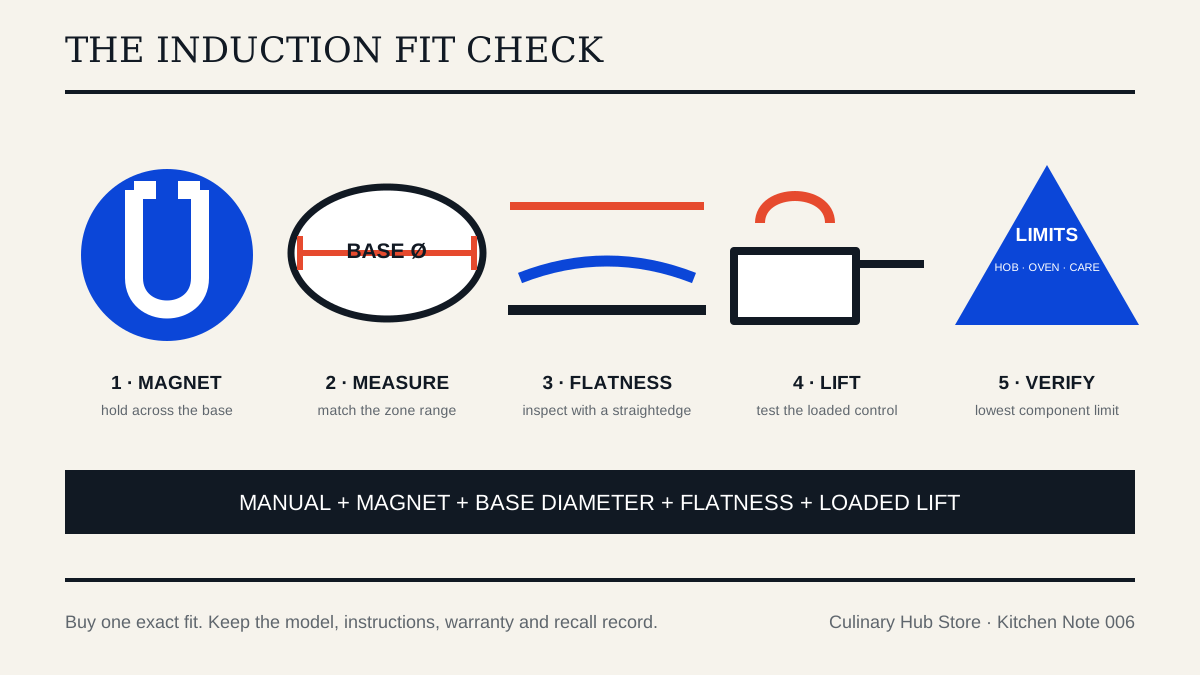
Induction shopping often gets compressed into one instruction: bring a magnet. That test is useful, but readers repeatedly report the next layer of problems—cookware that attracts a magnet yet is not detected, a listed diameter that describes the rim instead of the magnetic base, a pan that rocks on the glass, a handle that is awkward under load, or an “oven-safe” statement that omits the lid and knob.
The U.S. Department of Energy explains the basic mechanism: an induction cooktop uses an electromagnetic field to transfer energy directly into suitable cookware. DOE’s consumer guidance says flat-bottomed pans that attract a magnet can work. Appliance documentation adds the details that matter at the counter. Current Whirlpool and GE guidance says the base material, flatness, magnetic-area diameter, zone size and position can all affect detection and output.
The goal is not to crown one material or set. It is to produce a short specification for a pan that fits the exact appliance, cooking tasks, storage and person using it. That approach can preserve cookware already in the kitchen and makes single-piece replacement easier than buying a set around one vague compatibility icon.
1. Test the working base, not the label
Start with the exact cooktop manual. Record each zone’s minimum and recommended pan-base diameter, whether bridge or flex zones have special rules, and any restrictions on surface finish, canning or cookware shape. Manuals differ, so a generic chart cannot settle the fit for a specific appliance.
With the cookware cool and away from an energized cooktop, place a small household magnet against the flat outside bottom. Test the center and several points toward the edge. The useful question is not whether a magnet touches some metal somewhere on the vessel. It is whether the broad, flat area intended to sit over the zone is magnetic as the cooktop maker requires.
Some stainless steel is magnetic and some is not. Aluminum and copper cookware can work when the design includes a suitable magnetic base. Cast iron and enameled iron are commonly magnetic, but weight, texture and flatness still matter on glass. Material names alone are not compatibility guarantees. Require an explicit induction statement for the exact model and verify it against the appliance manual.
Manual match
The exact appliance manual gives the zone limits, placement rules and prohibited forms.
Broad magnet hold
The magnet holds across the flat outside base, not only at one small center disc or the sidewall.
Model identity
The maker names the material stack, induction use and model rather than relying on an icon alone.
Cold inspection
The base is clean, dry and free of damage before it meets the cooktop.
A magnet test cannot reveal heat distribution, durability, handle comfort, coating condition or oven limits. It also cannot override a failed detection test on the owner’s cooktop. If a current pan passes the manual’s checks and performs the needed job, replacement may add no useful capability.
2. Measure the flat magnetic diameter
Cookware size is often listed across the top opening. Induction zones respond to the base. GE instructs users to measure the flat magnetic area on the bottom and notes that a minimum pan size may be required for activation. Whirlpool likewise warns that the number sold as the pan diameter is usually wider than the base and that a pan that is too small may not be detected.
Turn the cool pan upside down. Measure the continuous, flat magnetic area that can sit over the zone. Do not include a rounded wall, decorative ring, foot, or nonmagnetic area. Record top diameter separately because it affects capacity, lid fit and access, but use the working base diameter for cooktop fit.
| Measurement | How to record it | Decision it supports |
|---|---|---|
| Flat magnetic base | Diameter of the broad base area that holds a magnet | Zone detection and match |
| Top opening | Inside diameter at the rim | Food access and lid size |
| Total handle span | Outside edge to farthest handle point | Storage, adjacent zones and oven fit |
| Loaded mass | Empty pan plus typical food and liquid | Safe lifting and control |
| Overall height | Base to highest lid or knob point | Oven, shelf and cabinet clearance |
Centering matters. A compatible pan placed far off-center can confuse detection or heat only part of the base. A very large pan does not make an undersized zone heat beyond its coil. Match the pan to the job and zone rather than assuming the largest diameter is more capable.
If the kitchen uses several zones, map the cookware collection to them. A small saucepan may need the smallest zone; a wide skillet needs a broad magnetic floor; a long griddle may require an approved bridge zone. A five-minute base inventory can reveal that only one piece is missing.
3. Check flatness, finish and glass contact
Whirlpool’s cooktop-care guidance recommends checking the bottom with a straightedge and looking for gaps as the edge is rotated. Perform that inspection on a clean, cool pan. A vessel that rocks, spins or shows damage needs review under its maker’s instructions before use. A slight engineered shape and harmful distortion are not the same thing, so do not hammer, bend or grind cookware to “fix” it.
The outside finish also has to suit the cooktop. Rough cast iron, burrs, baked-on residue and damaged base coatings can mark glass. Whirlpool tells users to keep pan bottoms clean and dry and to lift cookware rather than slide it. Weight improves neither compatibility nor care: a heavy pot still needs controlled placement, and a lightweight pan still needs a sufficiently stable base.
- Inspect the entire outside base under good light.
- Reject sharp edges, loose attached discs, severe dents, flaking exterior coatings and unexplained movement.
- Set the cool pan down gently; do not use the glass as a cutting board or landing surface for other tools.
- Keep salt, sugar, grit and dried residue away from the contact area.
- Follow the appliance procedure for spills, especially melted plastic or sugary residue.
Buzzing by itself is not a universal failure test. Sound can vary with pan construction, power level, contents and appliance. If noise is new, severe or paired with detection errors, movement, smell, visible damage or repeated shutoffs, stop and consult the manuals or qualified service rather than guessing from a forum clip.
4. Test the loaded lift, handle and lid
A pan that couples perfectly with the zone can still fail the kitchen. Estimate the loaded mass of a typical meal. With the cookware cool, add an equivalent safe weight and use the dry mitts normally kept nearby. Lift, tilt and move it to the intended landing area. Check wrist angle, helper-handle clearance and whether the handle becomes crowded by another pan or projects into a walkway.
CPSC tells cooks to turn handles inward to reduce spills and keep children and pets away from the cooking area. That rule works only if the handle can stay clear of an adjacent hot zone. Map the whole cooktop, not one circle.
Inspect handle fasteners, lid rim, knob and any removable silicone or plastic pieces. A 2026 CPSC sauté-pan recall involved a handle-related metal cap that could detach forcefully when heated, causing impact and burn hazards. That specific recall does not make every screw or rivet unsafe. It shows why the buying record needs maker, model, product identifier and a recall check, and why new looseness deserves attention.
A well-fitting lid can reduce splatter and support low-moisture cooking, but it changes height, weight and oven limits. Check whether steam can escape as intended. Never improvise a replacement lid that can slip into the vessel or trap pressure on cookware not designed for it.
5. Verify heat, oven, broiler and care limits
Induction compatibility covers the cooktop base. It says nothing by itself about oven, broiler, dishwasher, utensil or coating limits. Write down the lowest limit among every component: vessel body, bonded or attached base, interior coating, exterior finish, long handle, helper handle, lid, knob, gasket and removable sleeve.
Use the appliance and cookware instructions for preheating. Induction can respond quickly; maximum power is not a default preheat setting. Avoid heating an empty pan or shocking hot cookware with cold water unless the exact maker directs otherwise. Sudden temperature differences can distort cookware and can damage coatings or glass.
The 2026 FDA Food Code is a model for retail and food-service regulation rather than a consumer cookware shopping law. Its equipment chapter still offers a useful design benchmark: food-contact materials should be safe, durable, corrosion-resistant, nonabsorbent, smooth and easily cleanable under normal use. It also says cookware with a perfluorocarbon resin coating should be used with nonscoring utensils and cleaning aids. For a home purchase, translate those principles into exact material identity, cleaning instructions and replacement signs from the maker.
Before first use, wash as directed, inspect again, and make a small ordinary recipe instead of a maximum-power stress test. Note detection, sound, stability, handle control, cleanup and whether the pan fits the expected task. Retain the model details, instructions and proof of purchase needed for a warranty or recall.
6. Write the one-piece product brief
- Tasks.
Name the recurring foods, batch size, browning or simmering need, and whether the pan moves from cooktop to oven.
- Cooktop fit.
Record appliance model, chosen zone, allowed base range, placement rules and the required flat magnetic-base diameter.
- Envelope.
Set top diameter, total handle span, height with lid, capacity and maximum loaded mass the cook can control.
- Construction.
Require the exact food-contact material, core or attached-base description, coating identity, handle attachment, lid material and exterior finish.
- Limits.
Record induction, oven, broiler, dishwasher, utensil, preheat and temperature-change instructions for every component.
- Care.
Require cleaning, drying, stacking, storage and replacement criteria that fit the actual kitchen.
- Traceability.
Keep maker, model, identifier, instructions, warranty contact and CPSC recall-search result.
Compare this brief with the cookware already owned before shopping. A magnet and ruler may show that several pieces fit. Replace a failed capability with one well-specified vessel rather than buying a set that duplicates sizes or crowds storage.
Pair the cooktop fit with the rest of the workflow: our roasting-pan guide covers oven envelope and loaded lifting, the sheet-pan guide separates usable surface from nominal size, and the food-thermometer guide covers sensing area and cleaning limits.
Culinary Hub Store does not currently list branded induction cookware, prices, inventory, sellers, availability or checkout. Commercial details remain disabled until supplier authorization, complete specifications, accurate terms, fulfillment, returns and warranty handling are documented.
Questions cooks ask
How can I tell if a pan works on induction?
Read the exact cooktop manual, then test whether a household magnet holds across the flat outside base. Confirm that the maker identifies the exact model as induction compatible and compare its flat magnetic diameter with the zone’s allowed size.
Why does a pan pass the magnet test but fail to heat?
The magnetic area may be too small, the pan may be off-center, the base may be uneven, or the construction may not meet the appliance’s detection rules. The cooktop display and manual should identify the next check. Do not bypass a detection or safety feature.
Should the pan match the printed zone circle?
Use the manufacturer’s size range. Measure the flat magnetic base, not the wider rim. A smaller pan may operate at reduced power or fail detection; a larger pan will not expand the induction coil.
Can an induction pan go under the broiler?
Only when the pan maker explicitly permits it for every component. A magnetic base does not establish the heat limit of a coating, handle, lid or knob.
Curated reader notes
Notes selected for this guide
Share a page-specific measurement, compatibility check or care lesson. Product promotion and unverified price, inventory, availability, reseller or supplier claims are rejected.
Loading approved notes…