Kitchen note 007 · Knife care
Choose a knife sharpener that fits the knives you own
A sharpener is not a universal slot for “kitchen knives.” Start with the edge already in your drawer, separate maintenance from metal removal, verify the maker's angle and exclusions, then choose the least complicated system you can use safely and consistently.
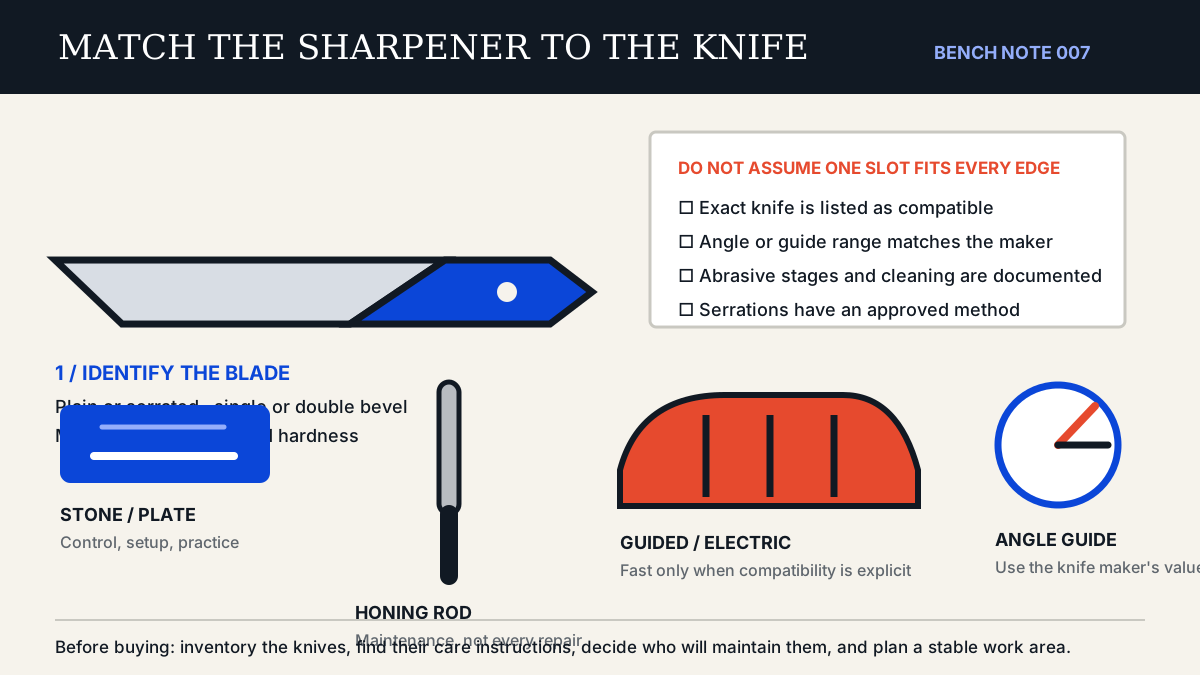
The shopping problem is usually framed as “whetstone or pull-through?” That skips the decision that matters first: which blades must the tool maintain? A double-bevel Western chef's knife, a thin Japanese-style blade, a single-bevel knife, a serrated bread knife, and kitchen shears may need different angles, abrasives, guides, or professional service. A convenient sharpener that does not match the edge can remove metal where you did not intend.
Make a knife inventory before comparing sharpeners
Write down the maker, model or line, blade style, edge geometry, and care instructions for every knife you expect the sharpener to handle. Look for a stated sharpening angle, whether the value is per side or inclusive, and whether the knife is single- or double-beveled. Note a full bolster that reaches the heel, recurved sections, scallops, or serrations; these can prevent a fixed guide or flat stone from contacting the whole edge correctly.
If the maker does not publish the angle or maintenance method, ask before choosing a fixed-angle product. Do not copy the angle from a visually similar knife. Even one brand may specify different angles for different lines: Zwilling's own instructions, for example, distinguish its standard knives from Santoku and Miyabi models. That is a useful warning against “all knives are 20 degrees” shortcuts.
Plain or serrated?
Many general sharpeners are for plain edges only. A serrated edge needs explicit compatibility or specialist care.
One side or two?
A symmetrical guide can be wrong for a single-bevel edge. Record the geometry before choosing a system.
Whose number?
Use the knife maker's specification and confirm whether the sharpener can hold it consistently.
Maintenance or repair?
A rolled edge, ordinary dullness, chips, and a broken tip are different jobs with different risk.
Honing and sharpening are not interchangeable
University of Kentucky's knife-skills guidance makes the distinction plainly: honing straightens and smooths the blade edge as a tune-up, while sharpening grinds or shaves metal to make a new edge. Utah State University Extension likewise describes a steel as a maintenance tool between sharpening sessions.
Product names muddy this distinction. Some “sharpening steels” are relatively smooth and primarily realign an edge; ceramic or diamond-coated rods are abrasive and remove material. Some multi-slot devices include both coarse sharpening and fine finishing stages. Do not buy by the word on the box. Identify the contact material, grit or stage, whether it removes metal, and which step the maker intends for routine maintenance.
A honing rod is not a cure for chips or a truly blunt edge. A coarse abrasive is not a daily ritual. The useful system gives each task a defined tool and tells you when to stop.
Compare the system, not the promise
| System | Best fit | What to verify | Likely mismatch |
|---|---|---|---|
| Bench stone or plate | Owners willing to learn angle control and maintain several compatible plain edges | Abrasive type, grit sequence, flattening or cleaning, lubrication, base stability, usable length | Someone who will not practice or cannot hold the specified angle consistently |
| Guided stone system | Repeatable angles on knives that fit the clamp and guide range | Angle range, clamp clearance, blade length and height, stone travel, single-bevel support | Flexible, very small, recurved, serrated, or unusually shaped blades not listed |
| Manual pull-through | A compatible, ordinary plain edge when the maker approves the angle and stages | Fixed angle, abrasive material, coarse/fine stages, heel access, pressure and cleaning instructions | Unknown angles, thin or brittle edges, serrations, single bevels, or a full bolster that blocks the heel |
| Electric sharpener | Frequent repeatable work on explicitly compatible blades | Angle, stages, blade types, duty cycle, debris capture, replacement abrasives, warranty | Occasional use where size, noise, cost, or aggressive material removal outweighs convenience |
| Honing rod | Maintenance of an edge and steel combination the knife maker permits | Rod hardness and material, length, guard, grip, angle guidance, cleaning | Repairing chips, recreating a bevel, serrations, or blades whose maker discourages a rod |
| Professional service | Damaged, unusual, serrated, hard, thin, expensive, or uncertain edges | Experience with the exact blade, stated method, angle control, turnaround, damage policy | A service that cannot explain its process or treats every knife identically |
Eight specifications worth finding before purchase
- Compatible edge types.
Plain, serrated, single-bevel, double-bevel, and shears should be named separately. “Kitchen knives” is not a compatibility list.
- Angle or adjustment range.
Confirm the exact angle convention and whether it matches the knife maker. A guide is only useful if its geometry fits the blade.
- Abrasive identity.
Look for the material, grit or stage, and whether replacement parts are available. “Diamond,” “ceramic,” and “fine” describe different things and are not interchangeable.
- Blade and bolster clearance.
Check minimum blade height, maximum thickness, clamp reach, heel access, and whether a bolster will stop the edge from reaching the abrasive.
- Stable setup.
A wide nonslip base, guarded hand position, secure clamp, and clear stroke direction matter more than a compact product photo.
- Cleaning method.
Sharpening creates metal and abrasive residue. The instructions should explain which parts open, rinse, brush, or stay dry and how residue is kept away from food.
- Storage footprint.
Measure the assembled tool, stones, guides, rods, power cord, and drying space. A system packed away damp or incomplete will not be maintained well.
- Documentation and support.
Look for model-specific instructions, replacement abrasives, warranty terms, and a reachable maker. Avoid unverified claims about universal compatibility.
Plan a clean, stable sharpening workflow
Use a dry, uncluttered counter with adequate light and a stable board or nonslip base. Keep the edge and your hands moving in the direction described by the tool maker; do not improvise a faster stroke. If an edge is chipped, bent, heavily worn, or behaving unpredictably, stop and use a qualified service rather than grinding until the damage disappears.
After sharpening, remove all metal and abrasive residue according to both manufacturers' instructions. FDA's home food-safety guidance says knives and other utensils should be washed with hot soapy water after each food item. The 2026 FDA Food Code further emphasizes clean, dry utensil storage and air-drying after cleaning and sanitizing in retail settings. For a home sharpener, the practical lesson is simple: keep sharpening debris out of food, wash and dry the knife before cooking, clean the tool as directed, and store both in a clean, dry place.
- Never test sharpness by running a finger along the edge.
- Do not sharpen toward an unprotected hand or on an unstable surface.
- Do not use a dishwasher as the default cleaning method unless both knife and tool makers allow it.
- Do not force a blade through a fixed slot or clamp that does not fit.
- Protect the finished edge in a block, sheath, rack, or other storage system designed for knives.
Print before shopping
Knife and sharpener compatibility sheet
Decision: compatible / needs maker confirmation / professional service
Questions shoppers ask most
Is a pull-through sharpener always bad?
No category label answers that. A pull-through can be convenient for a compatible plain edge when its fixed geometry, abrasive stages, and instructions match the knife. It is a poor gamble when the angle is unknown, the edge is single-bevel or serrated, the blade is unusually hard or thin, or the heel cannot enter the slot. Compatibility is the decision, not internet allegiance to a format.
Do all whetstones need soaking?
No. Water stones, splash-and-go stones, oil stones, ceramic stones, and diamond plates have different preparation and cleaning requirements. Use only the lubricant and method specified for the exact abrasive. Soaking the wrong product can damage it.
What about serrated bread knives?
Do not drag them through a generic plain-edge slot. Serrations vary in radius, spacing, bevel, and depth. Zwilling's published guidance says not to hone serrated knives and directs users to professional sharpening or replacement. Follow the exact knife maker's directions or use a service experienced with that pattern.
When is a professional the better buy?
When a blade has chips, a broken tip, an unusual bevel, serrations, a very hard or thin edge, or missing specifications, paying for the right service can be less costly than buying a system and learning on the knife. Ask what machine or abrasive the service uses and whether it preserves the factory geometry.
Pair the system with a stable prep surface: our cutting-board workflow guide covers board stability, cleaning, drying, and storage. If you are still building the core kit, the food-thermometer guide uses the same specification-first approach.
Primary sources and research notes
- Utah State University Extension: What to Look for in a Good Chef Knife — honing, board choice, hand washing, drying, and protected storage.
- University of Kentucky: Knife Skills — distinction between honing and sharpening, hand washing, drying, and storage.
- Zwilling: How to Sharpen Your Knives — manufacturer-specific angles, rod hardness, stone instructions, and serrated-knife limitation.
- FDA: Food Safety at Home — cleaning knives and other cooking tools with hot soapy water.
- FDA Food Code 2026 — current model guidance for cleaning, air-drying, and protecting utensils in retail food settings.
Reader-question check: current public discussions repeatedly ask whether a pull-through is acceptable, whether a honing rod can replace sharpening, how to avoid a whetstone learning curve, and what works for serrations. Those questions shaped the buying brief; compatibility and care recommendations come from the primary sources above. Product prices, inventory, branded listings, and availability remain disabled pending documented supplier authorization and accurate commercial terms. Reviewed November 4, 2026.